A scraped knee here, a minor kitchen or shaving accident there, a nosebleed in the middle of the night, or a period that arrives earlier than expected: Bloodstains just happen so quickly in everyday life. And just as quickly, the question arises: How do you get rid of them? The good news: You can remove bloodstains—easily, reliably, and without any harsh chemicals. At least, if you know what you’re doing.
And in our next blog post, we’ll show you—with simple step-by-step instructions—how to remove fresh or dried blood from clothing, what works for bedding and sheets, how to remove blood stains even from a mattress, and which home remedies can help with fresh or dried blood stains on fabric, sheets, and mattresses. It also includes a handy overview and the most common mistakes you should avoid.
First things first: Why bloodstains are often so stubborn
It happened quickly, but unfortunately it won't go away that quickly. This is usually the case when blood ends up somewhere it doesn’t belong. It doesn’t matter at first whether it’s on a bedsheet, your favorite shirt, your underwear, or upholstery: the sight of the stain and your reaction to it are always the same. The problem is those rust-brown stains that are almost impossible to remove, because blood consists, among other things, of hemoglobin—an iron-containing protein pigment—as well as other protein compounds. These proteins are sensitive to heat. At temperatures around 40 °C, they coagulate and bond permanently with the fabric fibers. That’s why the rule for all bloodstains is: use cold water, never hot!
And as trite as this tip may sound, it’s THE one rule that really matters if you want to remove bloodstains without leaving unsightly marks on your fabric.
The Golden Rule:
Whether fresh or dried: If you want to wash out bloodstains, always use only cold water.
Hot water causes the egg white to coagulate and, unfortunately, permanently sets the stain in the fabric.

Immediate Steps: Removing Blood Stains from Clothing
Every minute counts here. After all, the easiest way to remove bloodstains from clothing is while the stain is still fresh. So set the garment aside for a moment and act right away—that’s best. If you resist the urge to take a moment to think it over, you’ll waste valuable time. And don’t worry: It doesn’t require any special knowledge or much effort.
Below, you'll learn what works right away for fresh stains and what can still be done about dried-on stains.
Removing Fresh Blood Stains from Clothing
After a scare, one thing helps more than anything else: a level head. If you act quickly, you almost always have the best chance of completely removing fresh bloodstains. In fact, most fresh bloodstains can be completely removed in just a few minutes, as long as you start right away with cold water. To help you know exactly how to proceed, here’s a simple step-by-step guide:
Step-by-Step Guide: Removing Fresh Blood Stains
- Take action now: Rinse the stain as quickly as possible under cold running water. The higher the water pressure, the better. Do not rub; instead, press the water through the fabric.
- Pre-treatment: Apply a small amount of bluu stain remover or baking soda paste directly to the stain and gently work it in. Please do not use circular motions; instead, always work in one direction, as circular motions will rub the stain deeper into the fabric and make it larger.
Our bluu tip for the perfect wash cycle:
For those who prefer to have an eco-friendly duo on hand for pre-treating stains:
The bluu Family Laundry Set combines the phosphate- and fragrance-free bluu laundry strips with our bluu stain remover soap, a vegan soap stick made with Greek olive oil and soapwort from the Alps, which was specially developed for pre-treating stubborn stains.
- Let it soak in: Depending on the product, let it sit for 10 to 15 minutes, then rinse it out very thoroughly with cold water.
- Washing: Wash the garment in the washing machine at the maximum temperature indicated on the care label. White clothing can often be washed at 60 °C, while colored items are best washed at 30–40 °C to preserve the colors.
- Check before drying: Wait until after washing to check whether the stain has really come out.
Almost everyone makes these 4 mistakes when removing bloodstains:
- Use hot water, because it causes the egg white to coagulate, making the stain even more stubborn.
- Rubbing instead of dabbing, which causes a stain to penetrate even deeper into the fibers and makes it larger.
- Put the visible stain in the dryer. The heat permanently sets whatever hasn't come out yet.
- Hang the garment directly in the closet after washing it, without checking to see if the stain is really gone. Once it's dry, it's much harder to remove.
Removing Washed-Away and Dried Blood Stains
Keeping a cool head is essential here, too. For anyone who has noticed a bloodstain too late, needs to remove dried bloodstains, or has even already put the affected garment through the dryer, the first step is to stay calm. That’s because even dried blood stains can often be removed—it just takes a little more patience and the right pre-treatment.
Here's the best way to go about it:
Instructions for Dried Blood: Remove Stains with the Right Pre-Treatment
- Soaking: Soak the affected garment in cold salt water for 30 to 60 minutes. To
do this,
dissolve about 5 tablespoons of salt in one liter of water.The salt will dissolve the dried-on protein deposits.
- Pre-treatment: After soaking, pre-treat the remaining stain with bluu stain remover or a baking soda paste, gently working it in and letting it sit for 15 to 20 minutes.
- Washing: Wash in the washing machine as usual, at the maximum temperature allowed according to the care label.
- For stubborn residue: Apply lemon juice to the stain while it's still damp, let it sit for 30 minutes, and wash it again.
CAUTION: Please be careful with colored laundry, as lemon juice has a bleaching effect.
And what should you do if you want to remove bloodstains that have already been washed?
Here, too, all is not yet lost. If you've already washed the garment and the bloodstain didn't come out, you can soak it again in cold salt water and pre-treat it. In many cases, soaking can surprisingly effectively reactivate even older stains.
IMPORTANT:
If your fabric has already been in the dryer, the heat may have set the stain permanently. In that case, unfortunately, professional dry cleaning is usually the only solution.
Natural Home Remedies for Removing Blood Stains from Fabric
Not every stain requires reaching for a bottle of cleaning chemicals. Especially when you don't have a gentle cleaning product like those from bluu on hand, simple household remedies can also help remove blood stains from fabric.
Here's an overview of what helps and when, and what to keep in mind:
| Home Remedies | Suitable for | Application | Not at |
|---|---|---|---|
| Cold water | All fabrics | Rinse immediately or blot dry | Never use while hot |
| Salt | Clothing, bedding | Dissolve 5 tablespoons in cold water and let soak | Delicate fabrics (test first) |
| Baking Soda / Baking Powder | Clothing, mattress | Mix with water to form a paste & let it sit | Dark colored laundry (may cause colors tofade) |
| bluu Stain Soap | Clothing, bedding | Apply to a damp spot and let it sit for 15 minutes | Wool, silk (test first) |
| Lemon juice | White Textiles | Apply, let sit for 30 minutes, then rinse | Colored laundry, silk (bleaching) |
| Aspirin / ASA | White clothing, bedding | Dissolve the tablet in 1 liter of water and let it soak | Colored textiles |
| Cornstarch | Mattress, non-washable upholstery | Apply the paste to the stain, let it dry, and vacuum it up | Do not pour water on the mattress |
|
What about hydrogen peroxide? Hydrogen peroxide from the pharmacy appears on many lists of tips. It can work for white fabrics, but with colored laundry or delicate fabrics, it can cause colors to bleed and permanently damage the material. If you want to harness the power of oxygen to tackle stubborn stains, a specially formulated Oxi Booster like the bluu snO₂ white Oxi White Booster*, as it delivers effective oxygen-based cleaning starting at 30 °C and contains no chlorine bleach. * Not suitable for wool, silk, or leather. |
|||
By the way, you can also find more tips on other types of stubborn stains, such as red wine, coffee, or grease, on our blog » Removing Stubborn Stains from Fabrics—Here’s How!.

When You Have a Break in Your Cycle: Removing Blood from Bedding
Blood on your sheets or underwear because of your period: It's really no big deal! Getting up in the middle of the night to rinse out the sheet isn't much fun, but it's the only thing that really works. If you do this, you have a very good chance of removing the bloodstains.
- Rinse immediately with cold water or soak the bedsheet in cold water
- Lightly pre-treat with bluu stain remover soap or baking soda paste and let it sit for a short time
- Wash at the maximum temperature allowed according to the care label, since white bed sheets can often withstand 60 °C, which is also advisable from a hygiene standpoint.
- For stubborn stains on white sheets, baking soda often helps. Gently rub it in, let it sit overnight, rinse with cold water, and then wash the sheets again in the washing machine.
OUR HYGIENE TIP:
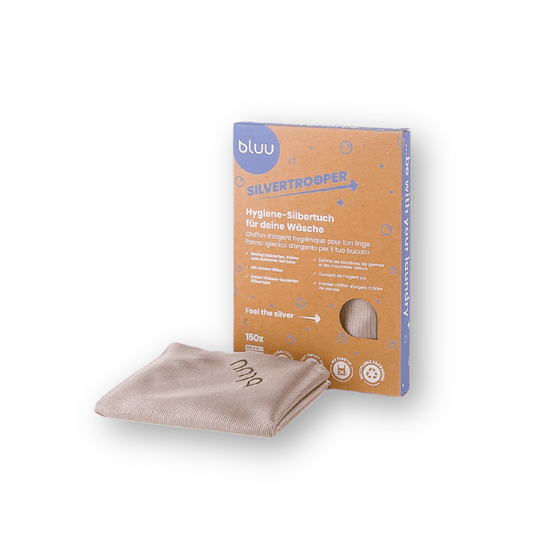
If you want your bedding to be truly hygienically clean after your period without having to use a chemical fabric softener, simply add the bluu silvertrooper hygiene silver cloth in the drum.
As a natural alternative, it has antibacterial properties, is fragrance-free, and is suitable for all fabrics. The silver ions leave a fresh scent on the laundry that keeps it smelling fresh for a long time, even after washing.
Removing Blood Stains from a Mattress: Here's How to Do It Gently
A mattress simply won't fit in a washing machine, and that's the real challenge. Unlike with clothing or bedding, there’s no quick fix here either. In addition, mattresses are naturally very absorbent and dry more slowly than other textiles. And if you use too much water, a damp environment develops inside the mattress, which in turn can promote mold growth.
THEREFORE, PLEASE NOTE: Never use too much water!
A mattress should only be damp on the surface and not soaked through. Damp mattresses can develop mold, which settles invisibly inside.
By the way, a mattress protector reliably shields the mattress from blood stains, saving you the trouble of having to clean it. It’s machine-washable and easy to care for.
If you don't have one, however, you'll find suitable procedures in the following two guides:
Step by Step: Removing Fresh Blood Stains from a Mattress
- Take action now: Dab the surface of the stain with a dry cloth or paper towel to absorb as much moisture as possible.
Important: Dab, don't rub!
- Damp cloth: Dampen a clean cloth with cold water, wring it out thoroughly, and dab the stain from the outside in. The cloth must be wrung out very well so that as little moisture as possible seeps into the mattress.
- Repeat: Repeat this until the cloth absorbs only clear water.
- Pre-treatment: Apply baking soda paste to the still-damp area, let it sit for 30 to 60 minutes, and then vacuum it up.
- Drying: Let the mattress air out thoroughly or dry it with a fan. Never use a hot hair dryer!
Important: Never blow-dry with a hot hair dryer!
Instructions for Removing Dried Blood Stains from a Mattress
Here, too, a little more patience is needed. Baking soda and cornstarch have proven particularly effective, as both draw moisture and dyes out of the material without soaking the mattress:
- Baking Soda Paste: Mix baking soda with a small amount of cold water in a 1:1 or 3:1 ratio to form a thick paste, and apply it to the stain. Then let it sit for several hours—ideally overnight.
- Vacuuming: Thoroughly vacuum up the dried paste. Then dab the area with a damp cloth.
- For leftovers: Gently dab a small amount of vinegar solution (made from 1 part vinegar and 3 parts water) onto the spot. Then let it sit for a while and gently blot it dry.
- Drying: In the final step, make sure to air out the mattress thoroughly using a fan or a hair dryer set to the cool setting. Of course, the mattress must be completely dry before you put new sheets on the bed.
CONCLUSION: Removing bloodstains isn't a big deal if you know how
That's exactly the good news. After all, the most important thing you can take away from this blog is that removing bloodstains from bedding and mattresses is just as manageable as removing a few drops of blood from your clothes.
Once you understand how bloodstains form and what works to remove them, you don’t need any special knowledge or a cabinet overflowing with cleaning products. Cold water, a little patience, and the right approach are usually all you need. If you also opt for gentle, eco-friendly cleaning solutions, you’ll be doing a favor not only for your clothes and bedding but also for the environment.
After all, with the right products—like those from bluu—a frustrating everyday situation can be literally solved in the blink of an eye.
Explore More Sustainable Tips & Laundry Solutions
FAQ on Removing Blood Stains
-
01 What’s the gentlest way to remove blood stains from mattresses that doesn’t use perfume or chemicals?
-
02 Which cleaning product is dermatologically tested yet still effective at removing stains?
-
03 Which eco-friendly cleaner is powerful enough to remove stubborn blood stains from fabric?