Whether draped over your favorite armchair, the sofa, as a living room rug, or a cozy liner in a stroller: a sheepskin is rarely just for decoration. It’s used, touched, brought to life, and becomes a part of everyday life in many different ways. It’s precisely this daily closeness that makes it so popular, but sooner or later it also leaves its mark: a spilled drink here, dust and odors there, or simply a dull, flat pelt that has lost its original luster.
Our blog post explains, step by step, how you can wash and gently clean your sheepskin in such cases without damaging the leather or compromising the natural structure of the fur. You’ll learn whether and when it’s appropriate to use a washing machine, which household remedies are effective, and how to restore the sheepskin’s softness afterward. The article includes specific guidelines, clear “if-then” recommendations, and a table showing which treatment is suitable for each type of sheepskin.
Washing Furs: Differences Between Sheepskin and Lambskin
Doesn't it matter how I go about washing a pelt? It’s not quite that simple, because all too often the terms “sheepskin” and “lambskin” are used interchangeably, even though they refer to very different products. Sheepskin, for example, comes from adult animals and usually has coarser, more robust fibers, making it well-suited for high-traffic areas such as rugs or seat cushions. Lambskin, on the other hand, has a finer, softer, and denser pile and is often used for baby mats, strollers, or as a cozy blanket. The difference is clearly evident when it comes to care: lambskin is more sensitive to heat and mechanical stress, while sheepskin is somewhat more forgiving.

Before you begin: What type of sheepskin do you want to wash?
Not every sheepskin can be treated the same way. The type of tanning is what really matters here.
Vegetable-tanned and medicinally tanned hides can be washed in the washing machine. Salt-tanned genuine hides, on the other hand, should only be spot-cleaned by hand.
Hides that have been tanned with aluminum salts must never be completely soaked. Water would leach out the salts and permanently damage the hide.
The following table shows you the most common types of tanning and how to identify them:
| Type of Tanning | Distinguishing Features | Washing machine? | Recommendation |
|---|---|---|---|
| Medically tanned | Slightly yellowish leather page, soft | Yes (30°C) | Wool cycle and gentle spin |
| Vegetable-tanned | Natural, light-colored leather side | Yes (30°C) | Wool cycle and gentle spin |
| Salt-tanned / Aluminum salt | No label or "do not wash" | No | Dry cleaning only, or take it to a professional cleaner if necessary |
| Unknown / no label | No care instructions available | No | To be on the safe side, dry clean only |
If in doubt, check the care label, which is usually located on one of the short sides of the pelt and is often sewn into the leather side.
If the label is missing or illegible, the following applies:
It is best to dry-clean only.
If you're unsure, you can ask the retailer or test a small area in a hidden spot with a little water. If the leather side darkens and remains stiff after drying, it is most likely salt-tanned leather, which should not be wet-cleaned.
Washing a sheepskin: How often is it really necessary?
The simple answer: Less often than you think. After all, what ultimately unites both sheepskin and lambskin is an extraordinary property: their high lanolin content—the natural wool grease produced by sheep—which accounts for up to 25% of the raw wool’s weight. This natural protective layer supports the fleece’s self-cleaning properties and has the advantage that you’ll need to wash sheepskin far less often overall.
The basic rule:
Lambskin and sheepskin typically have a lifespan of 10 to 20 years when properly cared for. However, frequent washing unnecessarily accelerates the wear and tear of the lanolin layer and the leather’s structure.
- Under normal use—for example, as a decorative item or rug—it is therefore sufficient to clean the fur once or twice a year.
- For fur that is subjected to heavier use—such as in a stroller, as a mattress pad, or in households with pets— more frequent cleaning may be advisable.
Therefore, the following applies: Washing less often, but brushing and airing them out more often, is the better care routine.
However, here are the situations in which you should, ideally, always wash your sheepskin right away:
- As soon as fresh liquid stains appear
- acting quickly prevents unsightly, dried-on stains
- After several weeks of heavy use

How to Clean Sheepskin Without Washing It: These 5 Methods Are Usually Enough
Not every stain requires a thorough wash right away. And not every instance of heavy wear and tear in everyday life requires a wet wash right away either. For most everyday situations, the following methods are more than enough to clean your sheepskin without having to wash it:
Tip 1) Shake Out & Air Out
To do this, take the fur outside, gently shake it out, and then hang it in the fresh air—ideally in a covered, well-ventilated area. The fresh air activates the self-cleaning properties of the lanolin layer, and even mild to moderate odors often disappear on their own after just a few hours.
Tip 2) Brushing the Fur
In fact, some dried-on stains can often be brushed out directly using a fur brush or a special lambswool brush. Whenever possible, always brush gently and evenly in the direction of the fur. Regular brushing—ideally once a month—prevents matting and tangles in the fur. If you don’t have a suitable brush on hand, you can also use a lint roller for light cleaning.
Tip 3) Baking Soda for Odors
Baking soda is simply THE all-purpose household remedy—and it’s also great for eliminating odors when caring for sheepskin. To use it, sprinkle it generously on the wool side and let it sit overnight—ideally for 12–24 hours—before brushing it out thoroughly. During this time, baking soda effectively neutralizes musty odors without damaging the fibers or the leather side.
As a general guideline:
For a sheepskin with a leather length of 80 to 100 cm, you'll need about 1 to 2 large cups, or roughly 200 to 400 g of baking soda.
Tip 4) Vinegar and water for light stains
It may be hard to believe, but vinegar and water is also a simple yet effective home remedy for cleaning your sheepskin without having to wash it. To do this, simply mix a solution of one part vinegar and three parts lukewarm water on a clean cloth and gently dab the light stain—always be gentle and never rub. Then lightly wipe the treated area with clean water and let the sheepskin air dry.
Tip 5) Spot Treatment
For individual fresh stains, it’s often enough to blot them immediately with a clean, damp cloth— but please don’t rub. For stains that have already dried, you should first try to loosen them carefully with a dry fur brush. Treat stubborn stains on the wool side with a damp cloth and a little mild wool detergent, keeping the leather side as dry as possible.
Important:
Always test cleaning products on an inconspicuous area first . Colored furs, in particular, may bleed if treated improperly. Colored furs are generally more delicate and should only be dry-cleaned.
Can you wash a sheepskin in the washing machine?
When it comes to sheepskin and washing machines, people often ask—and quite rightly so—whether you can wash a sheepskin in the washing machine or if it’s better to wash it by hand. Our clear and honest answer: Yes, but only under certain conditions.
Here, it’s worth taking another look at our chart of tanning types, because only medically or vegetable-tanned hides are compatible with the machine. Salt-tanned hides are ruined by machine washing; the tanning salts are washed out, and the leather hardens permanently.
So if you have medically or botanically tanned sheepskins and want to use a washing machine and gentle cycles to clean them, our step-by-step guide below will provide you with the guidance you need. We’ll also show you an equally simple and safe guide for gentle hand washing at home.

Step-by-Step Guide: Cleaning Sheepskin in the Washing Machine
- Preparing the fur: Use a brush to loosen dried-on stains and remove any loose material.
- Washing on your own: Place the fur in the drum without any other laundry, as other fabrics can damage the fibers or cause them to bleed.
- Correct program: Always select the wool cycle or, alternatively, the delicate/gentle cycle or hand wash cycle, and wash at a maximum temperature of 30°C.
- The Right Detergent: Use a mild wool detergent that is free of bleach, fabric softener, and fragrances, if possible. Our bluu nonscents laundry strips, for example, are phosphate-free, completely fragrance-free, and suitable for all fabrics—including wool, silk, and even cashmere. Just one laundry strip per wash cycle is all you need.
OUR EXTRA TIP:
If you wash your sheepskin at 30°C on the wool cycle, you’re inevitably washing it at low temperatures. While low temperatures are gentle on the material, they’re less effective against bacteria and germs that cause musty odors.
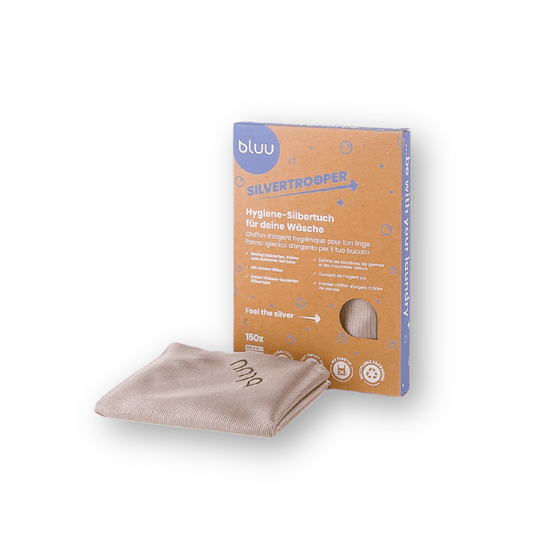
Our bluu silvertrooper compensates for this:
Simply add this hygienic silver cloth to the drum, and it will release silver ions that have an antibacterial effect without damaging the fur. - Skidding: Use only the gentle spin cycle at a maximum of 400 to 600 revolutions, as spinning at too high a speed can strain the leather and cause the fibers to become permanently matted.
- Remove immediately: Remove the fur immediately after washing and lay it flat to dry in a well-ventilated area, preferably on a drying rack or on a clean towel with the wool side facing down. While the fur is still damp, gently reshape it as needed—even several times.
Did you wash the fur? Don't forget to turn on the washing machine now.
Especially after washing a fur coat, dirt and fine wool fibers sometimes end up not only in the lint filter but also inside the machine and back out again.
This is the perfect time to give your washing machine a quick cleanup, too: Our bluu calcbusters Washing Machine Cleaner & Descaler uses the power of oxygen to remove limescale, grime, and odor-causing buildup from the drum, hoses, and detergent compartment. In short: A clean coat also loves a clean machine.
Alternative Step-by-Step Guide: Washing Fur by Hand
- Fill a tub or large bowl with lukewarm water (about 30°C).
➤ CAUTION: Do not use hot water. - Dissolve about 25 ml of mild wool detergent (equivalent to about half a bluu laundry strip) in one liter of boiling water and let it cool to 30°C.
- Spread the sheepskin out flat and immediately apply the soapy solution to the wool side using a soft cloth, a brush, or your hands.
➤ Gently work it in without rubbing or kneading, and keep the leather side dry. - Remove the soap residue with several clean, damp cloths until no foam is visible.
- Now gently shake out the fur (do not wring it) and then let it dry in a well-ventilated spot on a drying rack or laid flat on a clean towel with the wool side facing down. Gently reshape it several times while it dries, as leather cannot be reshaped once it is dry.
These 5 mistakes when washing sheepskin will ruin the fur:
- Temperatures above 30°C permanently destroy the lanolin structure and cause the leather to harden
- Regular laundry detergent or fabric softener can damage fibers and leather
- Vigorous spinning irreversibly mattes the wool
- Never use a dryer or heater, as they will make the leather hard and brittle
- Drying in the sun causes dyed hides to discolor and makes leather brittle
After Grooming: How to Make Your Fur Fluffy Again
Once the sheepskin is completely dry, feel free to fluff up its fibers several times with a fur brush. This will remove any matting and restore its fluffiness.
If, on the other hand, the sheepskin has become stiff after gentle washing, it can often be revived with regular brushing and exposure to air. This frequently happens when the leather has been dried either too quickly or under excessive heat. However, a stiff lambskin is rarely beyond repair and can often be made significantly more supple again with a little patience and the right care. In addition, a special lanolin spray can help replenish the natural oils that have been lost through use or cleaning.
It's important to be patient now:
- Gently knead and massage the completely dry hide with both hands, as this will make the leather a little more supple again.
- To help, you can apply a thin layer of leather conditioner or lanolin spray to the leather side and let it soak in.
- Afterward, the fur should be left to dry and rest in a well-ventilated area, and should be kneaded several times in between.
- If the leather remains stiff despite several attempts, a specialist shop or saddler can help by professionally treating the material.
How to Store Sheepskin Properly to Maintain Its Softness and Coziness for Years to Come
Ultimately, storing a sheepskin properly is also key to ensuring that you can enjoy it for a long time and that it remains soft and retains its shape.
With the following tips and simple habits, your sheepskin will stay well-maintained and protected for years to come:
- Store them as flat as possible or hang them on a wide rod, because hides that are rolled up or folded too tightly will develop pressure marks on the leather side.
- Protect from insect infestation, as moths and other pests tend to attack natural fibers, especially during prolonged storage. To do this, store the fur in a breathable bag or with lavender.
- Avoid direct sunlight whether using it as a decorative piece or as a rug, as UV rays cause colors to fade and make the leather brittle.
- Do not place heavy objects on it, as frequent and intense bending damages the leather's structure.
CONCLUSION: Cleaning Sheepskin: Genuine sheepskin doesn't require elaborate care—just the right kind
As you now know, caring for and washing a sheepskin is generally very straightforward, as long as you know three key things: what type of tanning it has, which method works best, and what to keep in mind when drying it. If you keep these tips in mind, you’ll enjoy your sheepskin for many years to come.
As for the machine, medically or botanically tanned fur can be washed effectively at 30°C using the wool cycle and a mild detergent.
For everything else, always opt for gentle care and, in addition, use products like those from bluu, which offer sustainable and effective support as eco-friendly laundry solutions for wool, delicates, and more.
Explore more smart TIPS & LAUNDRY SOLUTIONS
FAQ on Washing and Cleaning Sheepskin
-
01Can you wash a sheepskin in the washing machine?
-
02How often should you wash a sheepskin?
-
03How can you clean a sheepskin without washing it?
-
04Why Does a Sheepskin Become Stiff After Washing?
-
05What is the best detergent for sheepskin?